Big Question
Q. Why do sine and cosine NOT have asymptotes, but the other four trig graphs do? Use circle ratios to explain.
A. Asymptotes are considered undefined. Sine and cosine do not have asymptotes because the functions have a zero and will always have a denominator of one, and repeats forever.
Thursday, April 17, 2014
Wednesday, April 16, 2014
BQ#2 Unit T
Big Questions:
Q. How do the trig fractions relate to the Unit Circle?
A. If we focus on Sine, we know that sine is positive and negative on certain sides. The Unit circle is the same by expanding to a graph line, and not a circle. The periods will be the one time point that will go through the cycle. The amplitudes is the distance between the highest and lowest points on the graph. It is like the angle of a point in a unit circle.
Friday, April 4, 2014
Reflection #1 Unit Q
Questions
1. When you verify a trig function, it means you will have to solve the function until you get the same answer as the other side. You cannot touch the other side, that is your answer and cannot be changed
2. One of the tips is memorizing the ratio, rational identities. It helps a lot getting and you do not waste time while working on the test or problems. Also finding out what they have in common until I actually work on them.
3. Verifying trig function had one similar thing, and that is not touching the other side of the equal side. The on thing I would do is changing them to fractions and also change to the same trig functions. They always have something in common.
Wednesday, March 26, 2014
Wednesday, March 19, 2014
ID#3: Unit Q: Concept 1. Pythagorean Identites.
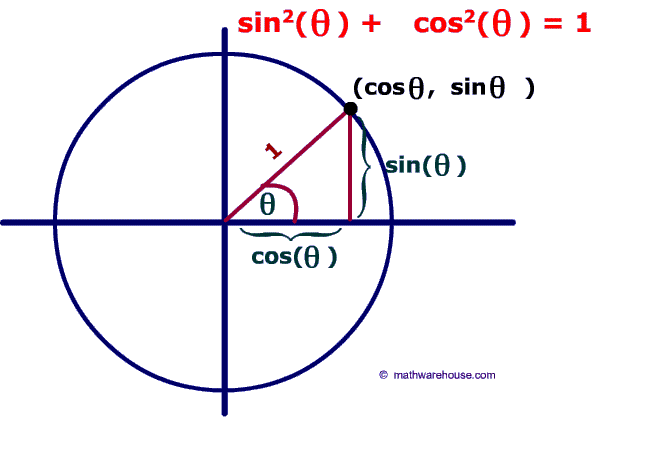
1. Where does where sin^2+cos^2x=1 come from to begin with? You should be referring to Unit Circle ratios and the Pythagorean Theorem in your expectation.
In this unit we have been talking about identity, which is the proof we show in order to understand or solve a problem. The Pythagorean Theorem is another way to prove a problem (a^2+b^2=c^2). In order to prove our answer right, we have to cancel it with the answer, if it is equaled to 1 or r^2, then it has to be canceled by 1 or r^2. Another example, will determine that we use the ratios of the Unit Circle. The ratio of cosine and sine is the same thing as the Pythagorean Theorem, it is just moved around.
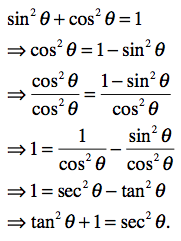
2. Show and explain how to derive the two remaining Pythagorean Identites from sin^2x+cos^2x=1. Be sure to show step by step.
a) Deriving Secant and Tangent [sin^2x+cos^2x=1] we will have to divide it by dividing it to cos^2x to get the inverse function od cosine, Sec.
b) you can simplifies it once more to get tan^2+1=sec^2X. (Tan^2x= sin^2x/cos^2x)
Sunday, March 16, 2014
BQ#1: Unit P Concept 4 : Area of an Oblique Traingle.
1. Law of Sines - Why do we need it? How is derived from what we already know?
The law of Sines is used for non-right triangles. For example, trig function is used for right triangles only. We need the law sine in order to find a side while we know the opposite angle. Triangles like AAS OR ASA, need to determine all three angles and sides.
It is derived by drawing a perpendicular line across from angle B. This will be called height. Once we have a height, we can solve any angle by using SOH CAH TOA. You equal the equation of the angle with the equation of the opposite side, and solve.
4. Area Formulas - How is the "area of an oblique" triangles derived? How does it relate to the area formula that you are familiar with.
The area of an oblique triangle is derived by having two side and one angle. The height is unknown, so we use the formula 1/2b(csinA). This equation is one out of the three that can be used, since we have three sides and angles. It all depends what they give you to start with. All students are familiar with A= 1/2bh to find the area of a triangle. This formula was used since they would give us the height. Now we do not get the height, so we substitute it with a side(sine of and angle).
Subscribe to:
Posts (Atom)