Pages

Hello

"Welcome Marisolr Math Analysis Blog"
Showing posts with label BQ. Show all posts

Thursday, June 5, 2014

Unit V; BQ#7

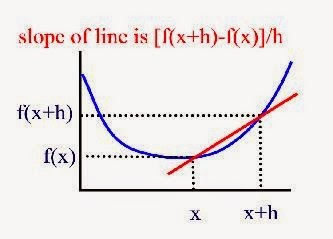
Q. Explain in detail where the formula for the difference quotient comes.

A. The difference quotient is related to the slope formula y2-y1/x2-x1. This means the difference quotient is a fancy way to find the slope of a graph. Also the problem that they give us to use the difference quotient, is just a formula of y=mx+b. we substitute the y-axis with the formula of f(x). This will give us f(x^2)-f(x)/x2-x1. The h is the horizontal direction you will have to go in order to get to the other point.

Sunday, May 18, 2014

Unit U BQ#6

Big Questions:
Q.What is continuity? What is discontinuity?
A. Continuity, is when the graph is predictable, it can go in any direction, it has no holes, jump or brakes, and you can draw it without picking up the pencil. Discontinuity is when the limit does not exist this usually occurs when there is a vertical asymptote.

Q. What is limit? When does limit exist? When does t not exist? What is the difference?
A. A limit is the intended height of the function. The limit exist when there is a removable discontinuity, a jump discontinuity. The limit does not exist when it occurs to non-removable discontinuity. The height of a function and the value is the actual height.

Q. How do we evaluate limits numerically, graphically, and algebraically?
A. Numerically- we create a chart in order to find the certain points of the limit or value.
     Graphically- Evaluate each graph with the name of discontinuity value.
     Algebraically- by plugging  in the x value, and figure out if it is indeterminate

Sunday, April 20, 2014

BQ#3 Unit T

Big Question
 
Q. How do the graphs of sine and cosine relate to each other?

A. Sine and cosine both have the denominator as zero, which makes them equal to one. They are inverse to their asymptotes, and makes slanted lines. The waves will always equal to zero, since the radius is the denominator.

Thursday, April 17, 2014

BQ#5 Unit T: Concept 3

Big Question

Q. Why do sine and cosine NOT have asymptotes, but the other four trig graphs do? Use circle ratios to explain.

A. Asymptotes are considered undefined. Sine and cosine do not have asymptotes because the functions have a zero and will always have a denominator of one, and repeats forever.

Sunday, March 16, 2014

BQ#1: Unit P Concept 4 : Area of an Oblique Traingle.

1. Law of Sines - Why do we need it? How is derived from what we already know?
The law of Sines is used for non-right triangles. For example, trig function is used for right triangles only.  We need the law sine in  order to find a side while we know the opposite angle. Triangles like AAS OR ASA, need to determine all three angles and sides.
It is derived by drawing a perpendicular line across from angle B. This will be called height. Once we have a height, we can solve any angle by using SOH CAH TOA. You equal the equation of the angle with the equation of the opposite side, and solve.


4. Area Formulas - How is the "area of an oblique" triangles derived? How does it relate to the area formula that you are familiar with.
The area of an oblique triangle is derived by having two side and one angle. The height is unknown, so we use the formula 1/2b(csinA). This equation is one out of the three that can be used, since we have three sides and angles. It all depends what they give you to start with. All students are familiar with A= 1/2bh to find the area of a triangle. This formula was used since they would give us the height. Now we do not get the height, so we substitute it with a side(sine of and angle).