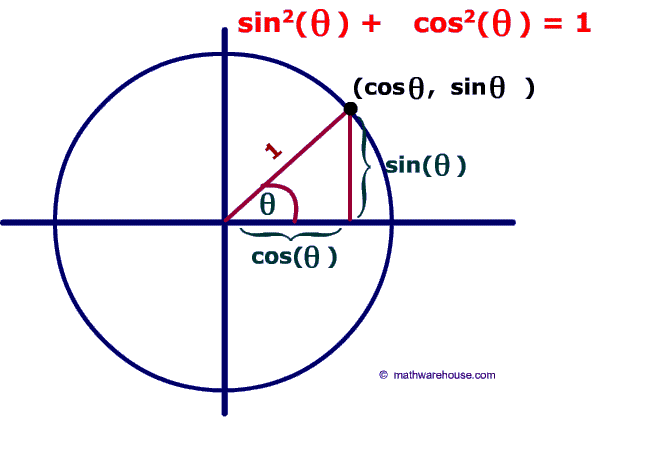
Before starting Concept 7-9 in Unit N, we worked on an activity that derives the Unit Circle. This means we got extra help for us to understand the Unit Circle. This activity will help us understand how to get the radians on the unit circle. This activity contained three triangles, and we had to label and draw coordinates.
First step: Label according to the rules of Special Right Triangles: You could have just googled "rules of Special Right Triangles" and would have gotten the hypotenuse is 2x, and one leg is x, the other leg is x radical 3.
Second Step: Simplify the three sides of the triangle fairly in a way such that hypotenuse equals 1: This meant that the hypotenuse has to equal one. In order to get 2x to equal one, is dividing it by 2x. This meant to divide everything in 2x, since it said simplify fairly. Hypotenuse=1, leg1= 1/2, and leg2=radical 3/2.
Third step: Label the hypotenuse "r": The hypotenuse is labeled "r"
Fourth Step: Label the horizontal value "x": Leg 2 is labeled "x"
Fifth Step: Label the vertical value "y": Leg1 is labeled "y"
Sixth step: Draw a coordinate plane for each triangle, with the origin being located at the labeled angle measured: You will have to draw a graph by the triangle, so the triangle will be on Quadrant 1.
Seventh Step: label all three vertices of each triangle as ordered pairs: Each corner of the triangle is a vertices, and has to be plotted. Also Labeled.
1. The 30 degree triangle is labeled and simplified, as the instruction has been explained. After you found the vertices, you will be able to find the radiant and vertices. This will always have a radical 3.
2. The 45 degree triangle is different than the 30 degree triangle. This will always have radical 2/2, or radical 2.
3. The 60 degree triangle is similar to the 30 degree triangle. This will have a radical 3, radical 3/3.
4. This activity helped me find my vertices of my unit circle, by using the special rights of triangle, and having the hypotenuse equal to 1. It also helped my find the radians of the unit circle. Before I will have not choice to just memorize the unit circle without knowing how to solve for them. This activity answered my question. If I forget the radian, now I know hoe to solve it.
5. If we place this triangle on a different quadrant, the signs will change. This is based on ASTC. When it lies on the first then all numbers will be positive. If it lies on Second then sine and cosecant will be positive, and the rest will be negative. Third quadrant, tangent and cotangent will be positive and the rest will be negative. Fourth quadrant, cosine, and secant will be positive and the rest will be negative.
1. The coolest thing I learned on this activity was finding out where did we get the different radians and vertices for the Unit Circle.
2. This activity will help me a lot by giving me a a second option on how to find the radian or degrees in my unit circle. In case I forget when I am trying to fill out by memory.
3. something I never realized before about special right triangle and the unit circle is that they are both derive information to me in order to find answers for concept 8 and 9.